The features were there. The discovery wasn't.
How a scattered set of vehicle tools became a single, actionable intelligence layer.
My role
Contributions: AI presentation framework, workshop facilitation, feature scope expansion, IA and interaction design, rules matrix co-design, cross-functional alignment on naming and framing
The starting point
We built a lot of useful features in the Driveway account center. Open recall alerts. Mileage-based maintenance reminders. Warranty expiration notices. Trade-in valuation signals. Financial health indicators. All useful features for managing your vehicle.
But the way people want to interact with technology is changing. People are busier. Attention is scarcer. The expectation is shifting from "I'll go find what I need" to "tell me what needs my attention right now." So, navigation and feature discovery are increasingly friction, not function.
AI isn't just a new tool for solving old problems. It's the right response to a fundamentally different user expectation, one where the right information finds you at the right moment.
That's the opportunity Vehicle Insights was built to meet.
A summary tells you things. It doesn't help you do anything.
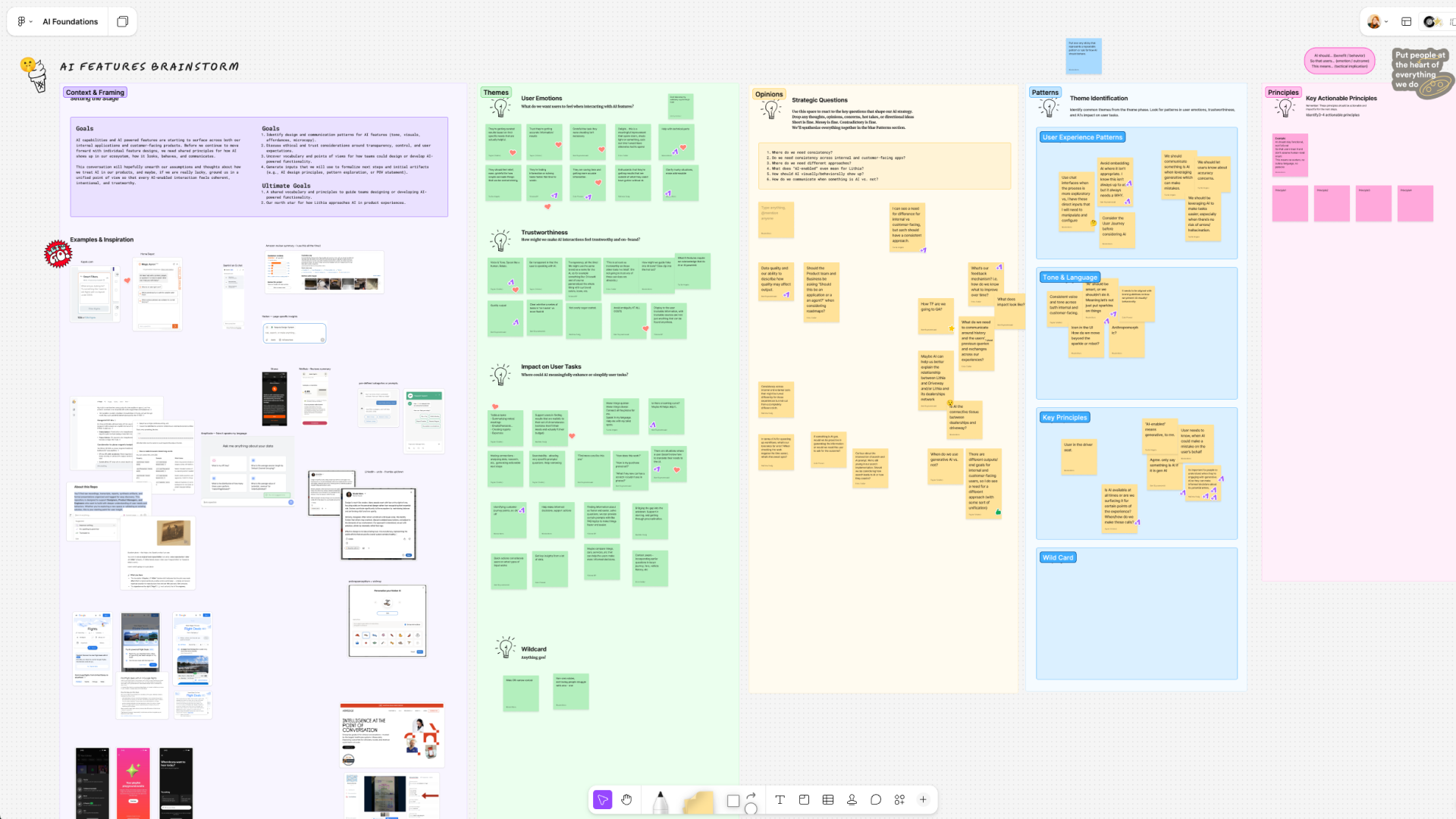
FigJam from AI Foundations workshop with Product Design team.
Before we built anything, we needed a point of view
AI capabilities were surfacing across internal tools and consumer products simultaneously, and our design team had no shared framework for how to introduce them responsibly. I hosted a cross-functional design workshop to work through the questions we'd inevitably face on every AI feature going forward.
When do we call something AI?
How do we earn user trust without overpromising?
What does responsible AI presentation look like on driveway.com?
The principle we landed on was, AI should stay functional, not fictional. No avatars, no cutesy language, no persona. And critically, only call something AI if it's actually generative. If it's algorithmic, call it what it is.
That framework became our north star. And it was immediately tested.
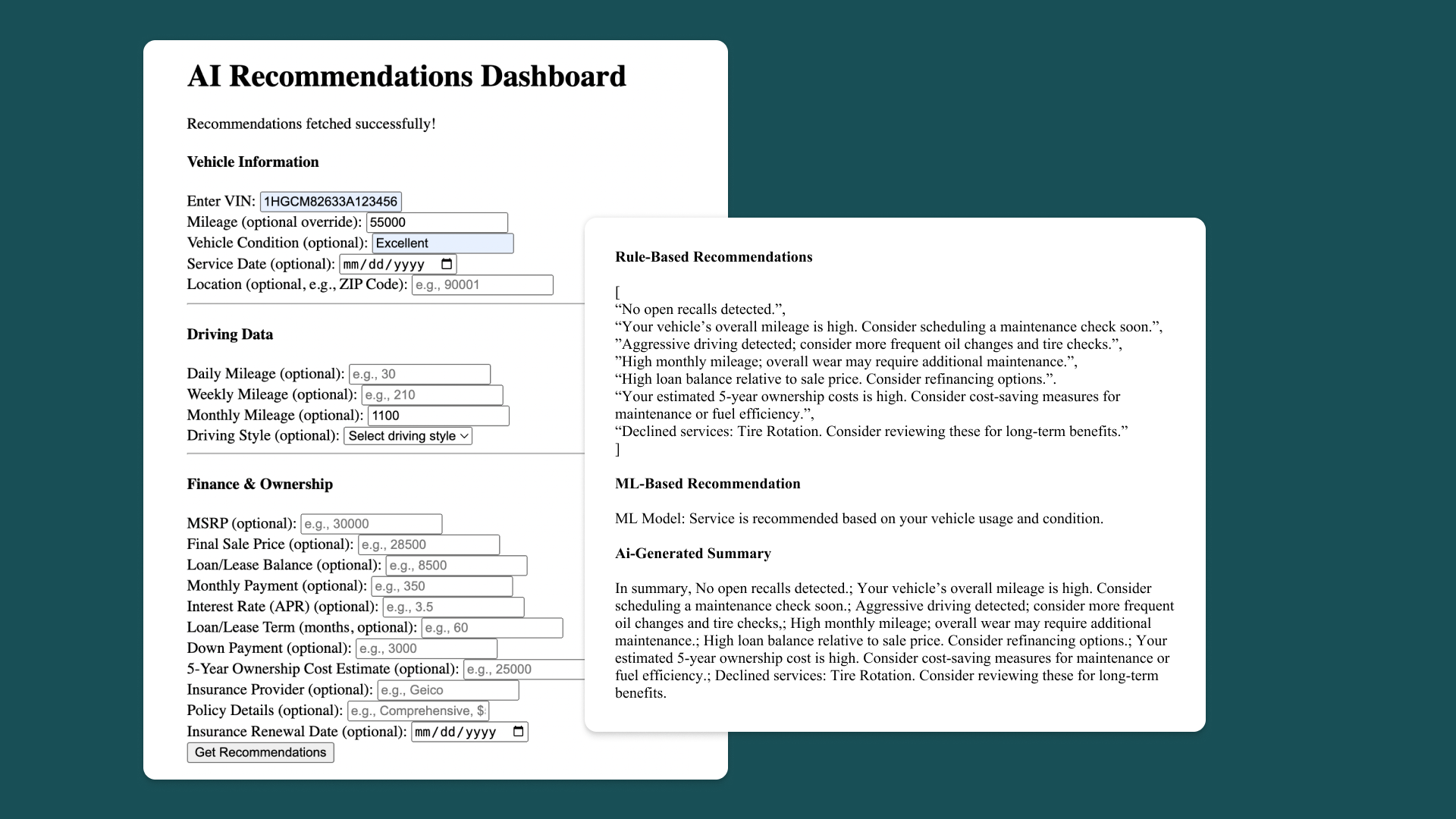
Original proof of concept for Vehicle Insights feature.
The ask
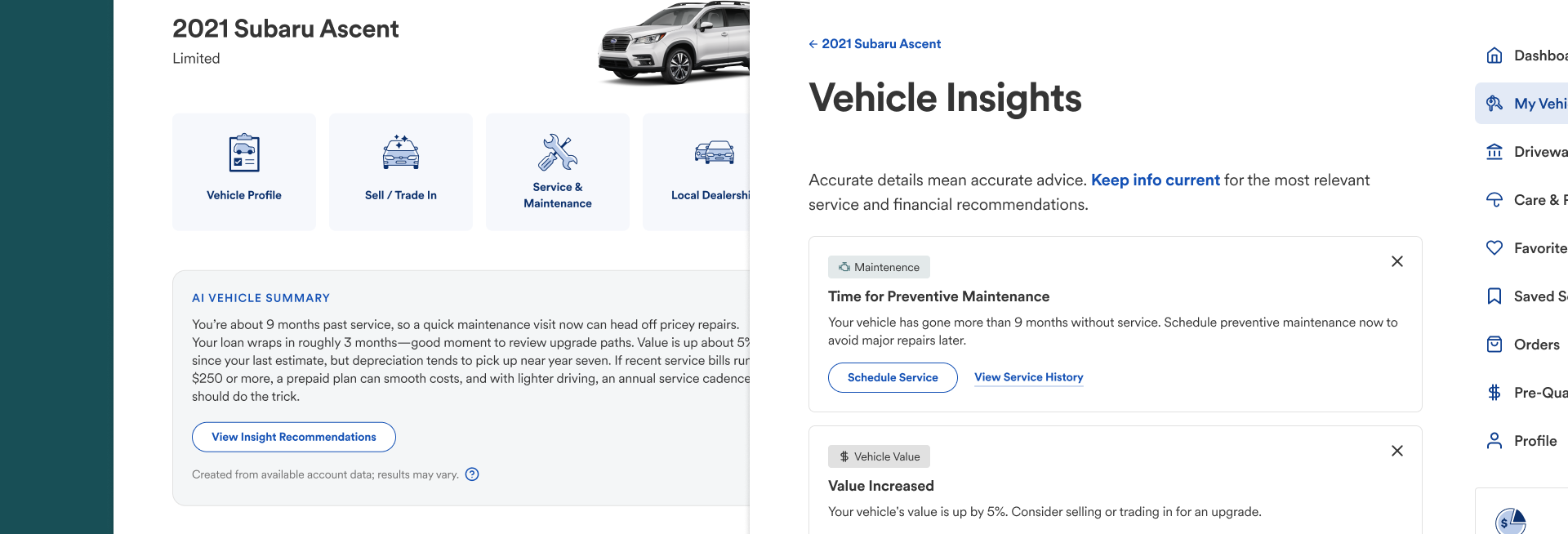
Product wanted an AI-powered summary that would run when a user landed on their vehicle page and surface relevant information about their vehicle's condition. Smart, useful, possibly overdue.
But as I looked at the initial concept, I kept coming back to the same problem: so what?
A summary tells you things. It doesn't help you do anything. And a user who just learned their 60,000-mile service is coming up still has to figure out where to go, what to do, and how to get there. The product was handing them information and calling it done.
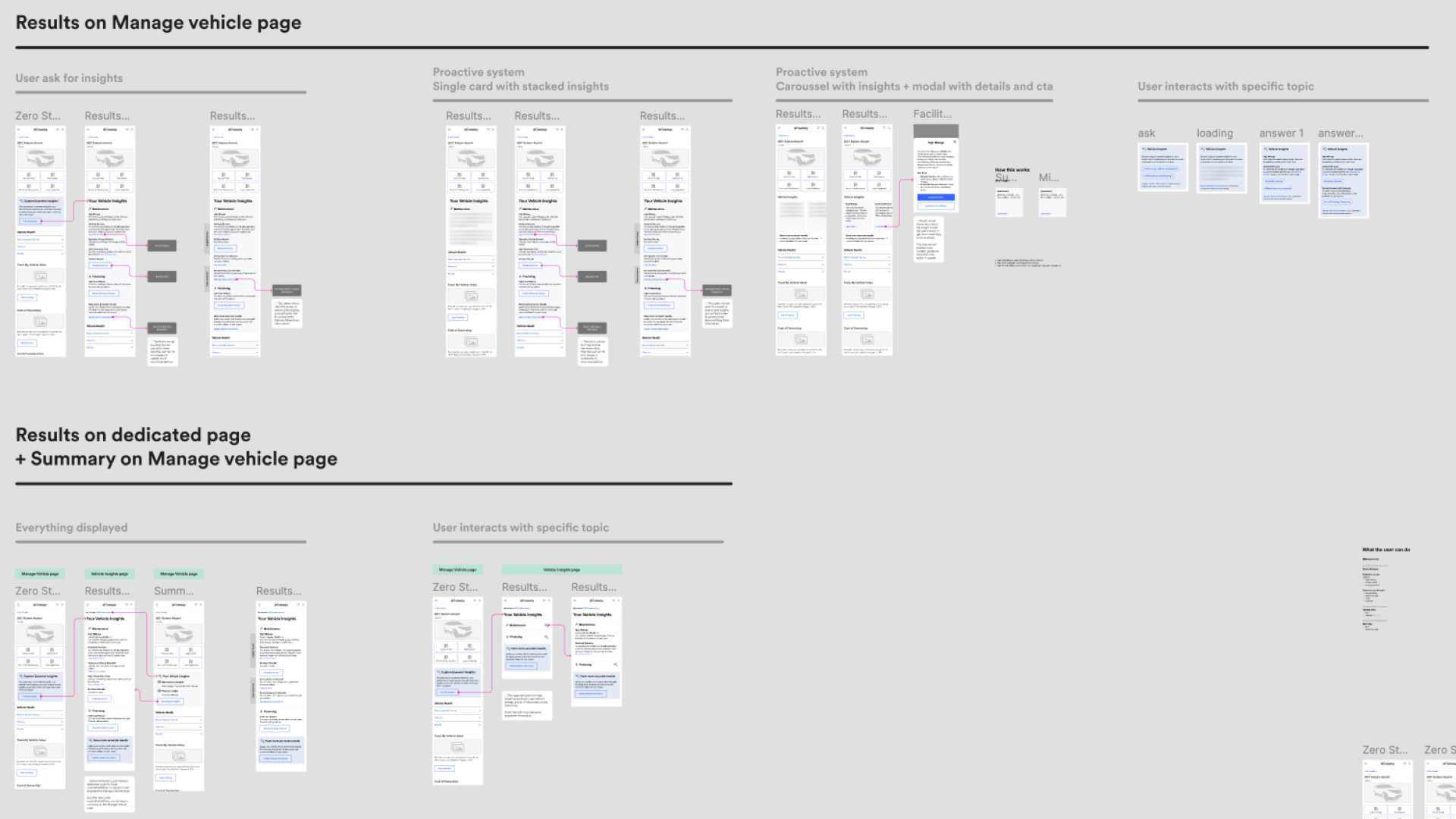
Lo-fi iterations of Vehicle Insights feature.
Information without action isn't insight
I made the recommendation that the summary shouldn't just surface data. It should surface the specific action the user should take based on that data, right there, in the same moment.
I started lo-fis with that expanded scope, exploring several approaches: action cards inline on the same page, a carousel format, a dedicated recommendations page, and routing from the dashboard to a modal or dedicated page.
After reviewing the approaches with product, we didn’t embed AI recommendations directly in the dashboard because they were designed as a deep, decision‑oriented experience with explanations, CTAs, state, and optional AI summaries. The two-layer model we landed on, a natural language summary card that routes to a dedicated page with categorized action cards, won out for clarity and scannability. It gives users a quick read at a glance and a clear path forward if something applies to them.
The feature shipped with those actions. The scope expanded and the ask got better.
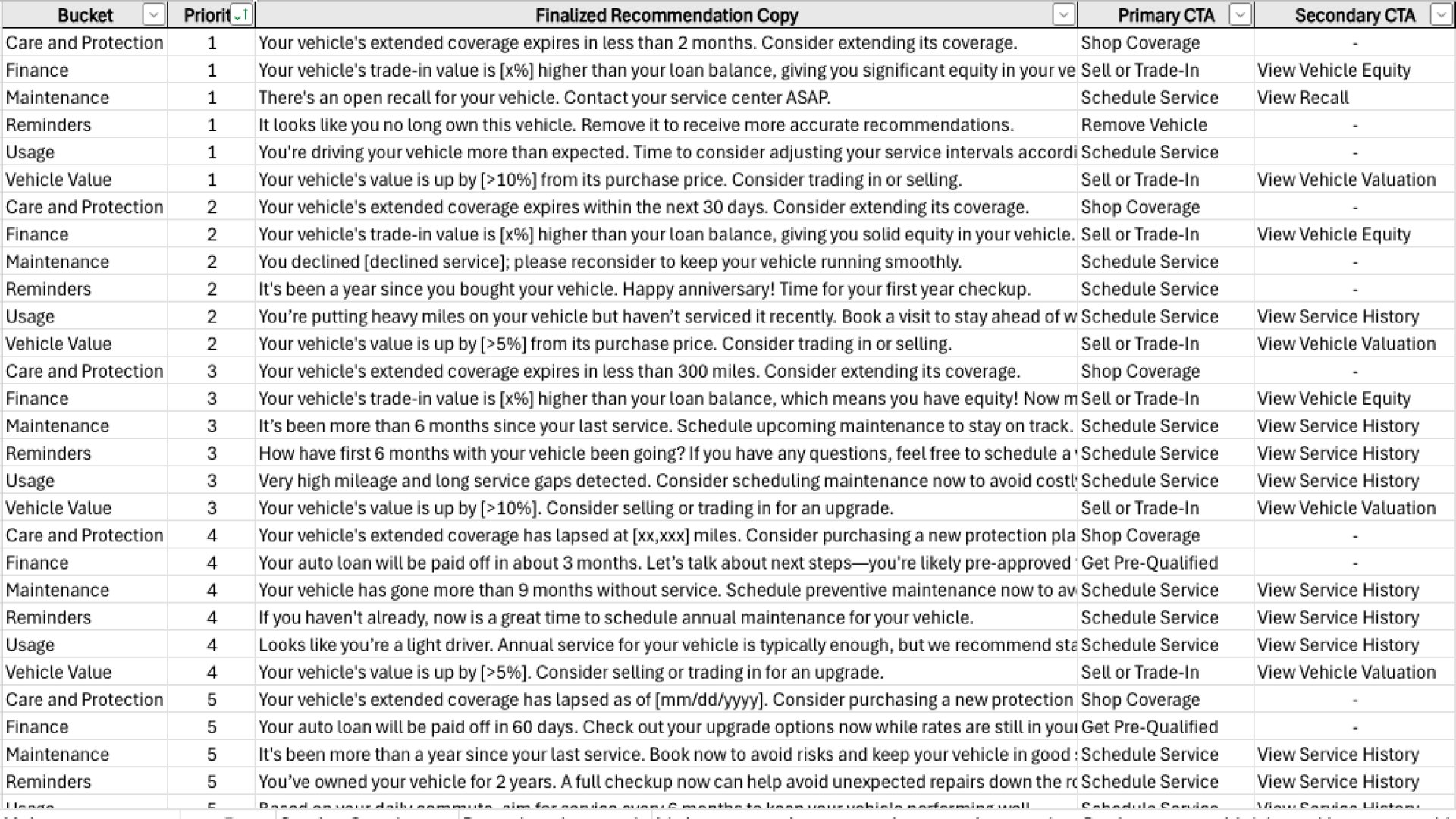
Rule-based recommendation matrix.
The real design work was the matrix
To make the action layer systematic rather than arbitrary, the Product Manager and I built a rules matrix together. Over 100 triggers across seven categories, each one priority ranked, mapped to a data source, a recommendation, and a specific CTA. Then a content designer wrote messaging for each trigger recommendation which acted as the voice and tone guideline for the LLM.
The matrix draws from third-party vehicle data, Lithia's service and sales transaction history, extended coverage and warranty records, real-time market valuation data, and user-entered information like mileage, driving style, and vehicle condition.
The AI summary is generated by passing all rule‑based recommendation outputs into a single prompt that asks an AI model to act as a vehicle ownership advisor and produce a concise, conversational summary without generating new recommendations or accessing raw data.
This matrix is the intelligence behind what looks like a simple card. Getting it right meant understanding not just what data we had, but what a user should actually do with it.
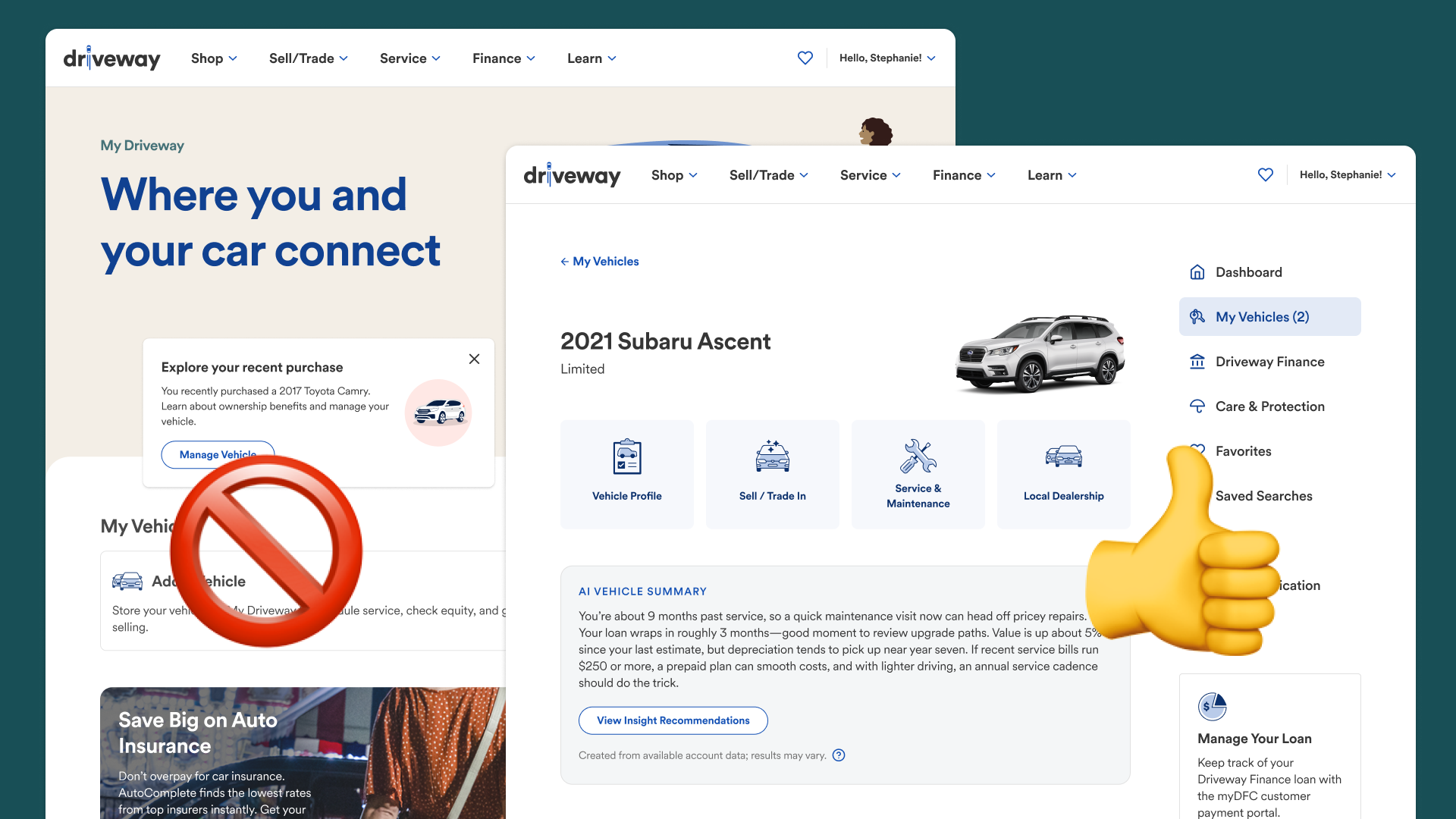
A scope decision worth noting
The original vision was to surface the summary card on the My Driveway dashboard, front and center on login. For a user with something time-sensitive, that placement would have been immediately valuable.
It didn't ship there. Generating the AI summary incurs incremental LLM cost per request, and placing it on the dashboard would mean generating it for every logged-in user on every visit, regardless of whether they had active recommendations. The business case for that cost wasn't there yet. The feature was scoped to the vehicle detail page, where a user is already in context and the summary generates on demand.
It was the right call. The rules engine delivers the recommendation value. The AI summary layer enhances it. Scoping the placement to match the cost model was disciplined product thinking, and it got the feature shipped.
29% of users who engage go on to take a recommended action.
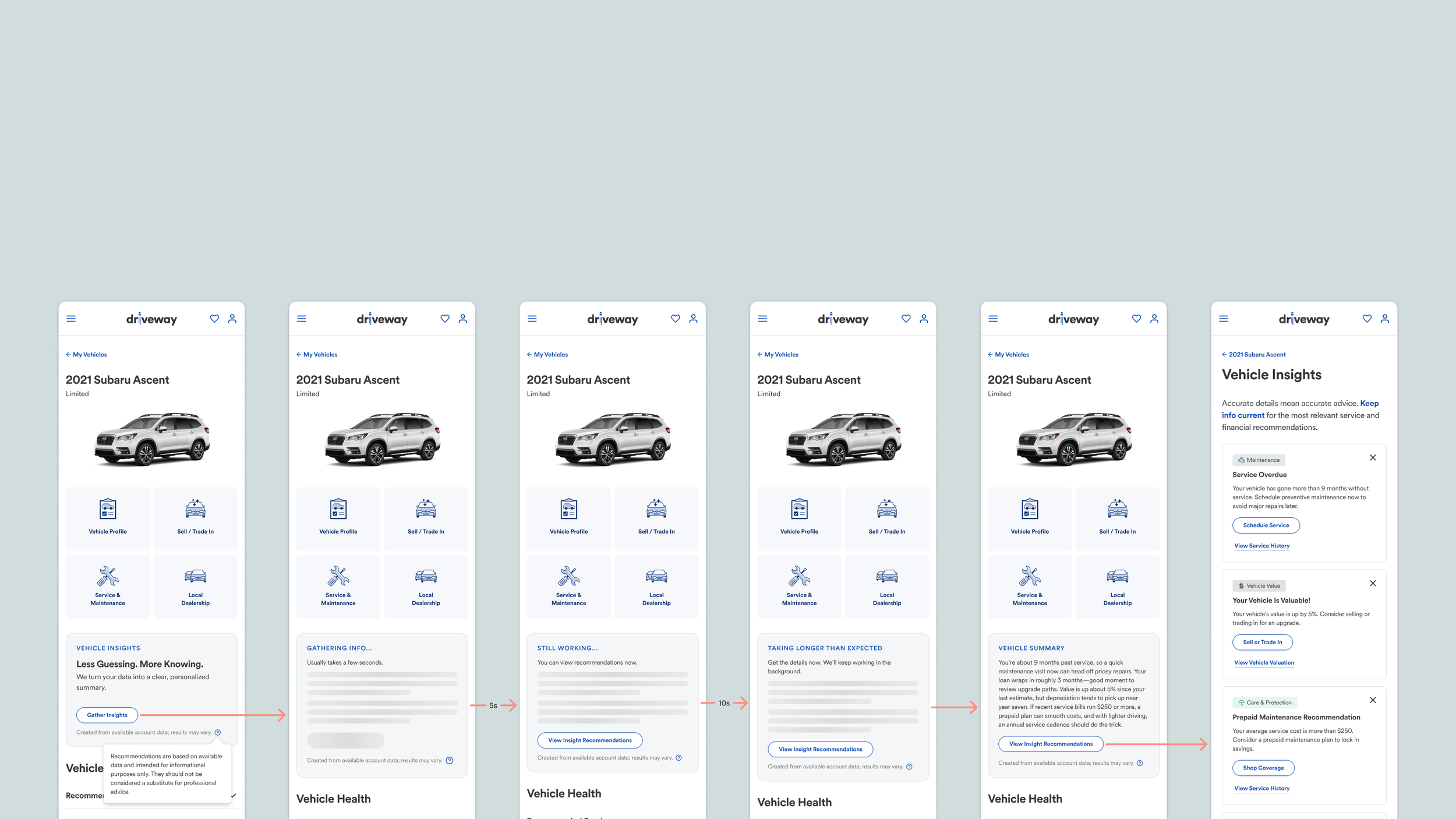
Final hi-fi of the Vehicle Insights feature.
What shipped
A vehicle intelligence layer that’s user initiated, prioritizes by urgency, and tells users exactly what to do next, not just what to know.
Since launching in March '26, the feature has grown at an average of 0.9% month over month, currently sitting at a 2% opt-in rate. That number is worth understanding in context. Vehicle Insights is a passive feature with no push notification, no onboarding prompt, no interstitial. 29% of users who engage with the summary go on to take a recommended action.